https://www.wonarm.com/the-true-map-of-hawaii-an-ultimate-guide-to-all-137-islands/
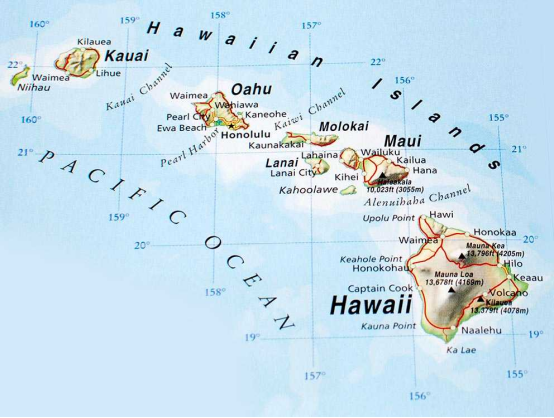
When we see Hawaii on a map, the image we see is often just a few green dots scattered across the Pacific Ocean. For most people, Hawaii is a holiday paradise with coconut trees, beaches and surfing. But did you know that the true geographical scope of Hawaii is much larger than the “eight islands” we usually know?
In fact, Hawaii is not just eight main islands, but a vast archipelago of about 137 islands, volcanoes and atolls , stretching nearly 1,600 miles (about 2,575 kilometers) across a large area of the North Pacific. In other words, it is a “chain of volcanoes” that records the magnificent history of the earth’s geological movements.
In this article, we’ll take a deep dive into the true nature of Hawaii, its geological origins, its hidden military history, and why it remains so important today.
Hawaii is more than just the “Eight Islands”
When people talk about Hawaii, most people think of O’ahu, Maui, Kaua’i, and the Big Island. These are indeed the most well-known islands in Hawaii and are often featured in tourism promotions. However, the true scope of the Hawaiian Islands includes:
8 main islands : The Big Island, Maui, Oahu, Kauai, Molokai, Lanai, Niihau and Kahoolawe.
129 small islands and atolls : scattered across the northwest Pacific, many are uninhabited and some are visible only at low tide.
The archipelago stretches from the Big Island of Hawaii in the southeast to Midway Island in the northwest, about 1,600 miles long , spanning almost one-third of the continental United States. If the entire chain of the Hawaiian Islands were placed on the continental United States, it would stretch from Florida to the Texas border.
How are they formed? The secrets behind volcanic chains
Hawaii was formed due to a geological phenomenon called a hotspot. Simply put, a hotspot is a hot plume deep in the Earth’s mantle that continuously delivers magma to the surface.
The Pacific Plate is moving
The Pacific Plate drifts slowly at a speed of about 10 centimeters per year, while the hotspot is almost stationary. So, as the plate moves, magma penetrates the plate to form volcanoes, and then cools to form islands.
A track of time
is like dripping wax on a moving conveyor belt. Each drop of wax takes shape after cooling, and the direction of the wax drops is the order of time. The Hawaiian Islands are a “geological timeline”:
Youngest : The Big Island of Hawaii, which still has active volcanoes (such as Kilauea).
Oldest : The northwest-facing islands, such as Midway Atoll, were formed about 28 million years ago.
Midway Island: A Military Fortress Hidden Deep in the Ocean
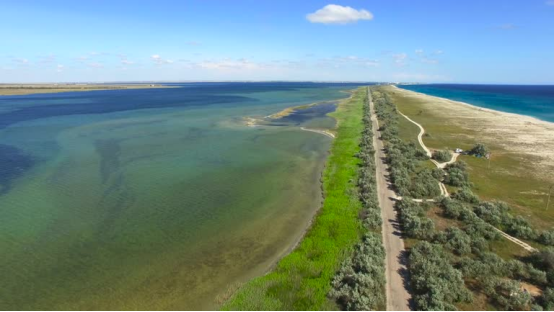
Among the 137 islands, Midway Atoll is probably the most legendary one. It is located at the westernmost tip of the Hawaiian Islands, about 1,240 miles from Honolulu. Its unique geographical location gives it its name – it is located at the “midpoint” between Asia and North America.
a key player in World War II
, is not only a geographical landmark, but also a turning point in history. In 1942, the Battle of Midway Island became an important turning point in the Pacific War, where the US Navy defeated the Japanese fleet and turned the tide of the war. This battle is not only a classic in military history, but also established the strategic position of the United States in the Pacific.
Today, Midway Island is no longer a front line in the war, but a wildlife sanctuary, an important habitat for albatrosses, seabirds and sea turtles. However, it still retains the remains of the military base, silently telling the echo of history.
Why does Hawaii look so small? The map lies
Have you ever noticed that on maps, Hawaii often appears within a small box within the continental United States, making it look insignificant? This is not because Hawaii is really small, but an illusion caused by the map projection.
Problem with the Mercator projection : In order to maintain the direction of the route on a flat map, the map stretches high-latitude areas and compresses low-latitude areas.
The huge span in reality : If you put Hawaii back on the map in its actual proportions, you will find that the sea area it spans can be called a “Pacific Empire.”
The interweaving of culture and nature: more than just a tourist paradise
Hawaii not only has stunning beaches, but also a unique culture and ecosystem.
Cultural diversity : The Polynesian culture of the native Hawaiians blended with the cultures of later Asian and European immigrants, giving rise to a unique language, music and customs.
Ecological fragility : Due to long-term isolation, Hawaii has bred a large number of unique species, but it is also particularly sensitive to invasive alien species. Currently, Hawaii’s native plants and birds are facing unprecedented threats.
Hawaii’s Future: The Threat of Rising Sea Levels
Climate change not only threatens coastal cities, but also poses a huge challenge to the Hawaiian Islands. Scientific predictions show that in the next few decades, some low-lying areas in Hawaii may be flooded, and tourism, fisheries and residents’ lives will be seriously affected. This is not only a problem for Hawaii, but also a common crisis for island countries around the world.
Why you should rediscover Hawaii
Hawaii is more than a postcard or a honeymoon destination. It is a geological timeline, a history of war, a treasure trove of biodiversity, and a reminder that Earth’s story is far more complex than a dot on a map.
If you could step onto a Hawaiian beach one day, would you rather explore the power of volcanoes or dive into the deep sea to find the secrets of the atolls?
Feel free to share your answers in the comments section, and you can also forward it to a friend who is planning a vacation to Hawaii!
https://www.wonarm.com/the-true-map-of-hawaii-an-ultimate-guide-to-all-137-islands/